Every pipeline has a complete engineering history. Almost no operator can access it.
From pipe mill to decommissioning, a pipeline generates tens of thousands of compliance records across contractors, inspectors, and systems. That record is never assembled in one place. When regulators ask for it, operators spend weeks reconstructing what should take minutes.
This is not a data problem. It is a structural gap — and no existing platform was built to fill it.
PipelineCopilot is the concept for that platform. This document exists to determine whether a strategic software partner sees the same opportunity.
The Compliance Record Is Fragmented by Design
Pipeline construction produces evidence across every activity: material traceability, weld lineage, NDE acceptance, hydrotest data, coating inspection, commissioning records. That evidence is generated by multiple contractors, captured in incompatible formats, and stored wherever it was created — contractor binders, vendor portals, survey tablets, email threads.
The moment a pipeline enters service, the fragmentation compounds. Integrity digs, CP surveys, repairs, valve replacements, reroutes — each event adds records across different contractors and systems, none of them connected to the original construction record.
When PHMSA audits, when an incident demands investigation, or when an asset changes hands, operators must manually reconstruct the compliance narrative. Teams spend weeks pulling records from incompatible sources.
Asset management platforms track assets. Integrity management systems analyse risk. Document management systems store files. None of them were designed to treat compliance evidence itself as a lifecycle asset — structured, linked to the physical infrastructure, and continuously accumulated.
That gap is what PipelineCopilot addresses.
Asset DNA — Construction Sets It. Operations Accumulate It.
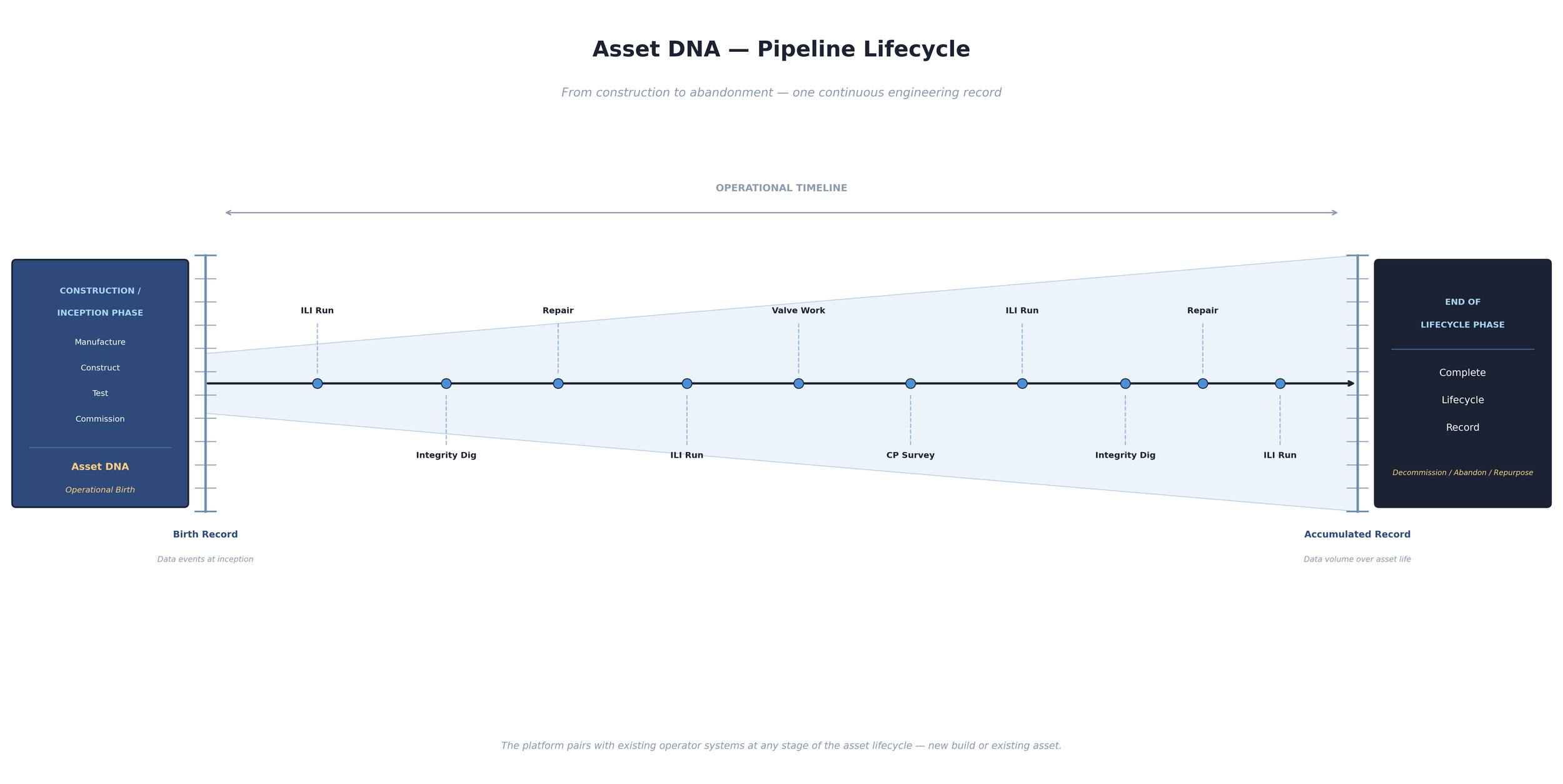
PipelineCopilot treats the compliance evidence of a pipeline asset the way a hospital treats a patient record — as a continuous, structured file that accumulates over the life of the asset and is accessible when it matters.
Construction is the natural entry point. Every pipe joint, weld, coating repair, and hydrotest produces evidence that PHMSA requires operators to retain for the life of the asset. Captured at the moment of construction, that record becomes the DNA of the asset — a verified starting point against which all future integrity events are measured.
From that foundation, PipelineCopilot accumulates evidence continuously: ILI runs and anomaly repairs tie back to original weld records. CP surveys build on the cathodic protection design from construction. Reroutes and replacements extend the DNA with new segments cross-referenced to the original. Decommissioning closes the record with a verifiable full-life history.
The platform does not replace the systems operators already have. It is the evidence layer those systems currently lack.
Where PipelineCopilot Sits
Pipeline operators already run the platforms they need to manage assets, model risk, and store documents. Those platforms do their jobs well. None of them were designed to treat compliance evidence as a structured, continuous asset record — captured at the moment of activity, linked to the physical infrastructure, and accumulated from construction through decommissioning.
That layer does not exist. It sits between the systems operators already trust. It is not a threat to any of them. It is the connective tissue they were all built without.
The company positioned to own this layer is not a startup. It is an organisation that already has operator trust, existing pipeline workflows, and a customer base that understands the compliance burden firsthand. The distribution is already there. The regulatory credibility is already there. The customer relationships are already there.
What does not yet exist is the product.
PipelineCopilot is the specification for that product. This document is an invitation to a small number of organisations — the ones already serving this industry at scale — to determine whether they see the same gap.
The Construction Wedge
Construction is the highest-density compliance documentation event in a pipeline's life. A single project generates thousands of records that operators are legally required to retain indefinitely. No existing platform captures this evidence in a structured, asset-linked format at the moment it is created.
A strategic software partner with relationships in pipeline construction can embed PipelineCopilot at the construction stage. The operator receives the completed asset with a structured compliance record already in place. Every subsequent integrity event, repair, and surveillance activity adds to that record.
The construction wedge is the competitive moat. An operator whose construction record lives in PipelineCopilot has their asset DNA in the platform from day one. The longer the asset operates, the more valuable the record becomes and the harder the platform is to displace.
Phase 1 development scope is defined: the Hydrotest Capture Pack. Complete technical specification exists — 26 appendices covering module definitions, JSON schemas, PDF dossier templates, RBAC model, mobile app offline design, and compliance mapping to PHMSA/API/ASME/NACE standards.
The platform is ready to build. It is looking for the right builder.
Frequently Asked Questions
What exactly is PipelineCopilot?
A compliance evidence capture and dossier management platform for midstream pipeline operations. It captures evidence at the point of activity, structures it against the physical pipeline asset, and delivers regulator-ready packages — PDF, JSON, GIS — defensible in any audit, investigation, or asset transfer.
Does it replace existing integrity management or asset management systems?
No. It complements existing IMS, GIS, document management, and SCADA systems. It fills the gap none of them were built for: structured, continuous compliance dossiers tied to pipeline segments and accumulated over the full asset lifecycle.
Where does implementation begin?
Anywhere on the asset lifecycle. For new build, evidence capture begins at material origin — pipe mill certificates, weld lineage, NDE acceptance, coating inspection, hydrotest, commissioning — and the asset enters service with a complete structured compliance record already in place. For existing infrastructure, implementation begins at the next compliance event: a re-verification hydrotest, a pre-weld NDE on a repair, an ILI run, a CP survey. The platform accumulates evidence forward from whatever the entry point is. There is no mandatory starting module.
How does the evidence architecture work?
Every compliance event — regardless of which contractor performed it or which system generated the source data — is captured against a segment identifier and GPS bounds. Evidence is structured at capture using defined input templates and validation rules, then packaged into a dossier with a SHA-256 hash at the point of submission. The result is a continuously accumulating, tamper-evident record tied to the physical asset, not to a project, a contractor, or a filing system.
How does contractor data flow work?
Contractors operate within the platform as part of the operator's workflow — at no cost to the contractor. The operator subscription covers access. When a job is complete, the contractor submits evidence against the operator's asset record through the scoped exchange portal. The operator controls the evidence record; the contractor has no ability to modify submitted dossiers. Contractor and operator data environments are separated — contractors access only the scope relevant to their active work.
What does a dossier contain?
A structured PDF (cover sheet, activity summary, evidence appendices, signatures, SHA-256 hash), machine-readable JSON, and GIS output (GeoJSON/Shapefile) linking all evidence to pipeline coordinates. Every dossier is independently verifiable and self-contained.
How is tamper-evidence maintained?
SHA-256 hash at capture, sync, and submission. Append-only ledger architecture. Optional private ledger (AWS QLDB / Hyperledger) or public blockchain anchoring (Polygon / Ethereum L2) for operators requiring external verifiability.
What about field operations in remote areas without connectivity?
The mobile application is offline-first. Evidence is captured locally with AES-256 encryption and queued for sync. Dossiers can be completed entirely offline and submitted on reconnection. No data is lost or held in an unstructured state during offline operation.
What regulatory standards are covered?
PHMSA 49 CFR 192/195, ASME B31.4/B31.8/B31.8S/PCC-2, API 1104/1163/RP 1110/RP 1117, NACE SP0169/SP0502, OSHA 29 CFR 1910/1926 including PSM, ISO 24817.
Is there AI involved?
Minimal and specific. OCR for calibration certificates and handwritten field records. Deterministic rule-checking for compliance validations. The core platform is rules-based and fully auditable — appropriate for a regulatory evidence context where explainability matters.
What security certifications are targeted?
ISO 27001, NIST 800-53, SOC 2 Type II. AES-256 at rest, TLS 1.3 in transit.
What is the current development status?
Pre-build. Architecture, module specifications, data schemas, compliance mapping, mobile application design, and development roadmap are fully documented across 26 technical appendices. The full specification is available on request.
This Document Is Shared by Invitation
The materials on this page — the platform concept, module architecture, and strategic framing — reflect a complete pre-build specification. Not a pitch deck. Not a proof of concept. A documented opportunity.
The conversations we are having are with a small number of organisations that serve the pipeline industry at scale. If you are reading this, you are one of them.
The full technical specification is available on request.